
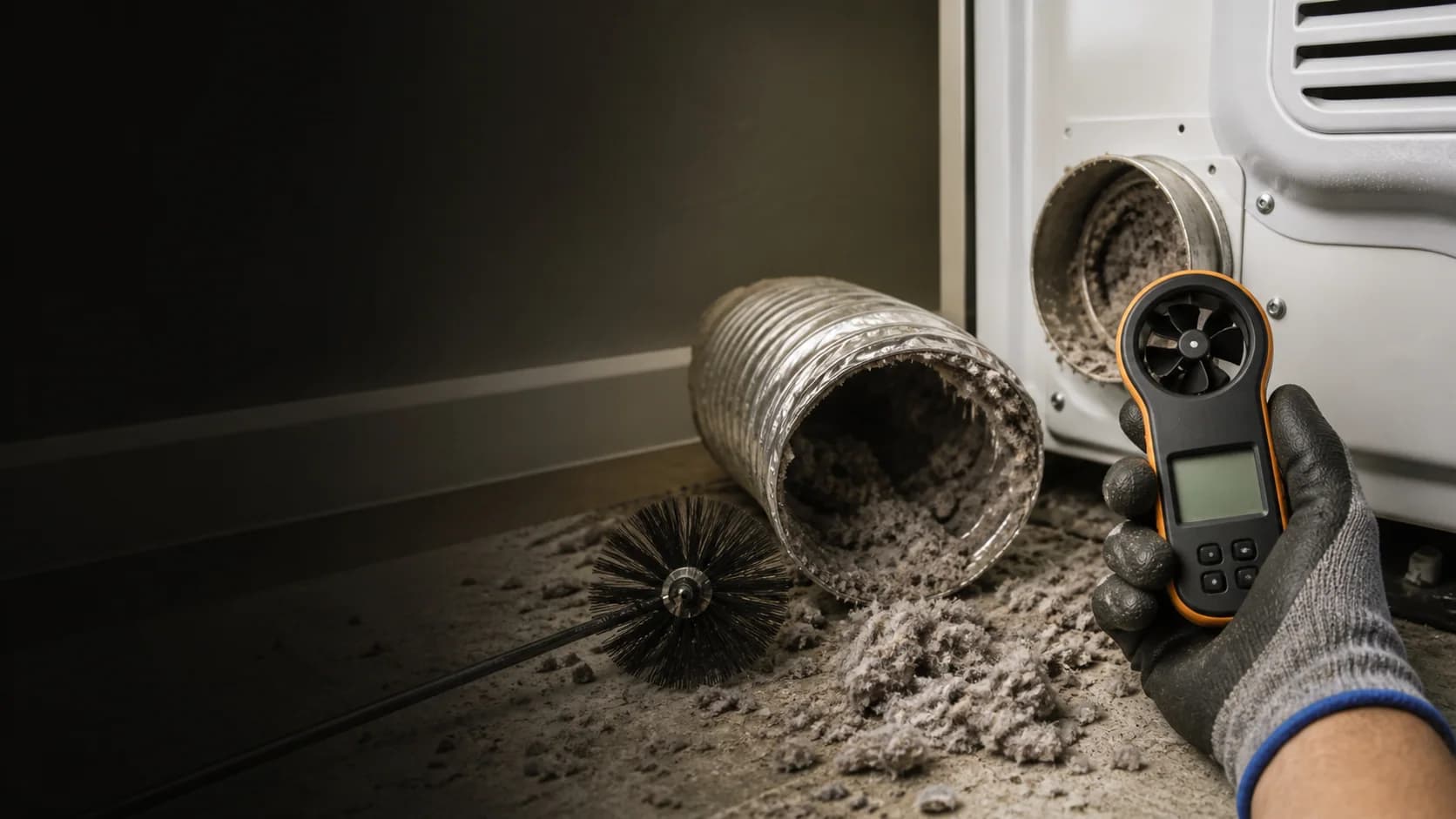
A dryer that tumbles but does not heat is one of the more common appliance faults, and one where the underlying cause matters more than the symptom.
Start with the venting
Before anything else: check the vent run. A blocked or badly-routed vent is the single most common reason a dryer stops heating, and it is also a fire risk, which is why it comes first here rather than last.
Lint accumulates along the whole run, not just in the filter. A vent that is crushed behind the machine, runs too far, or has too many bends will trap heat inside the cabinet. Many dryers respond by blowing a thermal fuse, which is a safety device doing exactly its job. Replacing that fuse without clearing the vent simply means it will blow again — and if it does not, the heat has nowhere to go.
If the outside vent flap does not open when the dryer runs, or the airflow feels weak, that is your answer.
The heating element and thermal fuse
On an electric dryer, a failed heating element produces exactly this symptom: the motor runs, the drum turns, nothing gets warm. The thermal fuse is a one-shot device that cuts the heating circuit permanently once it trips, and it is usually tripped by the airflow problem above rather than by age.
On a gas dryer the equivalent parts are the igniter, the flame sensor and the gas valve coils. Gas dryers are not a reasonable DIY repair.
If you smell burning
Stop using the dryer and unplug it. A burning smell from a dryer usually means lint has reached something hot, and continuing to run it is how a laundry fire starts. That is not a "book it for next week" situation.
Long dry times are the early warning
If clothes have been taking two cycles to dry for a while, that is the same airflow problem at an earlier stage. Dealing with it then is cheaper than dealing with it after a fuse blows.
Worth doing yourself
Clean the lint filter every load, and clear the full vent run at least yearly. That single habit prevents a large share of the faults on this page.
Getting it looked at
This is general guidance, not a diagnosis. The same symptom can have a cheap cause or an expensive one, and the only way to know which is to have someone measure it. A technician will find the actual fault and give you a fixed price before any work starts, so you can decide with a real number rather than a guess.